An Overview of Our Process at Jyuhachinichi (18th)
This section introduces how essential oils are produced at Jyuhachinichi (18th), the operator of JapanAroma. Under our in-house brand Kaoru Satoyama, we distill Japanese botanical essential oils using materials sourced primarily from the forests of Minami-Aizu, Japan.
While we curate and supply a wide range of Japanese fragrances, the essential oils distilled in our own facilities hold particular significance. They reflect not only the botanical characteristics of each plant, but also the climate, landscape, and human involvement that shape their production. Through this process, we aim to offer oils that accurately represent their place of origin.
Our Philosophy
At Jyuhachinichi (18th), our work extends beyond the act of distillation. We view essential oil production as a way to preserve and communicate the values embedded in the forests and agricultural landscapes where these botanicals grow.
Fragrance has the ability to connect people to nature in a quiet and tangible way. By maintaining close control over sourcing, processing, and evaluation, we strive to ensure that this connection remains honest, traceable, and consistent.
Sourcing Raw Materials
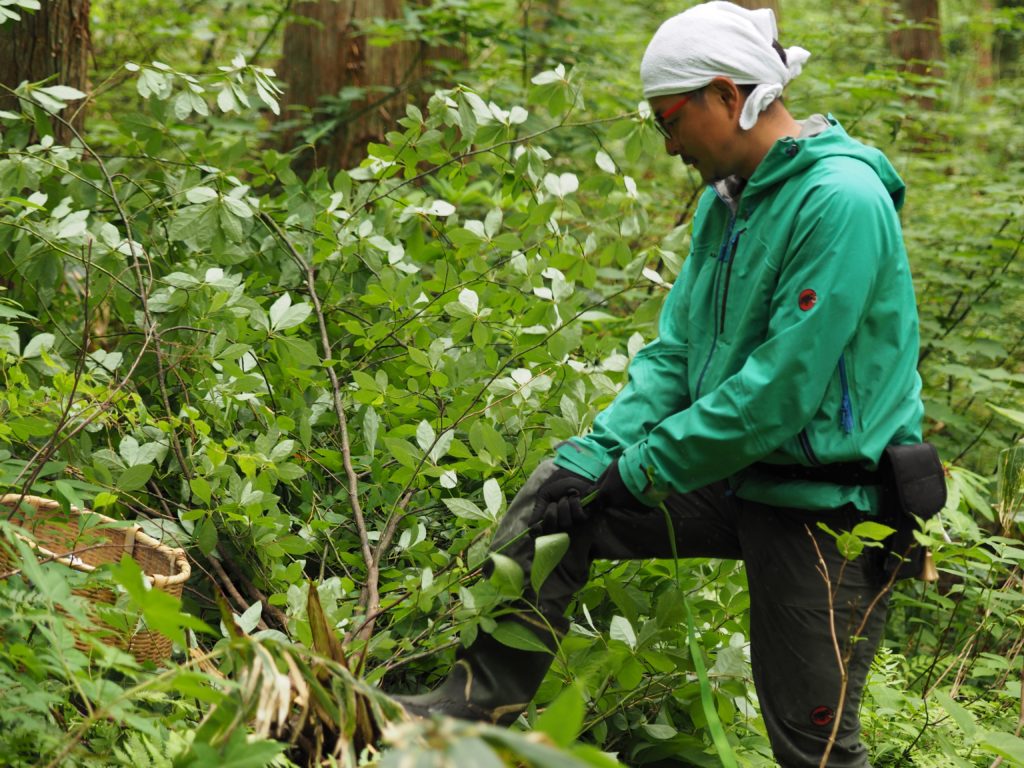
Our production begins in the forests of Minami-Aizu, where Kuromoji (Lindera umbellata), one of our key botanicals, is gathered. This region is characterized by a mix of coniferous and broadleaf forests, and Kuromoji grows particularly well in the shaded environments beneath coniferous trees.
With the cooperation of local residents who have deep knowledge of the mountains, branches are harvested selectively and by hand. Responsible gathering is essential. We collect only what is necessary, ensuring that the forest ecosystem can continue to regenerate naturally.
This careful approach forms the foundation of an essential oil that faithfully reflects its environment.
Working in Balance with Forests and Communities
Our activities are rooted in respect for both the natural environment and the people who live alongside it. Harvesting is carried out in close coordination with local communities, with consideration for long-term forest health rather than short-term yield.
This collaborative model allows us to continue production while maintaining the ecological balance of the region.

Preparation of Botanical Materials
Before distillation, harvested materials are processed using an industrial grinder to reduce them into smaller pieces. Increasing the surface area of the plant material allows steam to extract aromatic compounds more efficiently during distillation.
Although this step is straightforward, it is critical to the overall quality of the oil. The condition of the raw material at this stage directly affects extraction efficiency and aromatic clarity.
Distillation
Once prepared, the materials are ready for distillation.
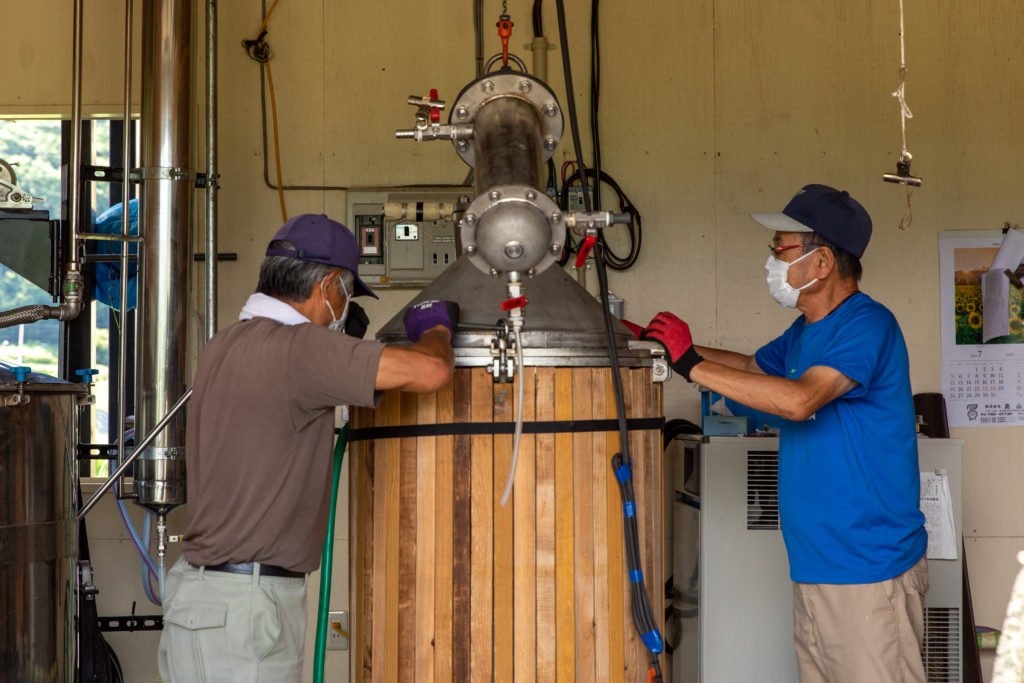
At our Minami-Aizu facility, we operate multiple stills ranging from 250 to 500 liters in capacity. Each still is selected based on the botanical material and the intended characteristics of the final oil. Our food-grade equipment also allows for the production of flavor extracts, providing flexibility across different applications.
One still in particular has been used extensively for Kuromoji distillation over many years. Through repeated use and accumulated experience, it has consistently produced batches that define the character of our signature oil.
Distillation requires precise adjustment of numerous variables, including particle size, packing density, steam flow, temperature, and duration. Prior to releasing Kaoru Satoyama Kuromoji Essential Oil, extensive trials were conducted to establish an optimal balance between aromatic profile and chemical composition.
Even today, distillation parameters are continually reviewed and refined through experimentation and data analysis. This process allows us to maintain consistency while preserving the natural expression of each plant.
Filter, bottle, and Ageing
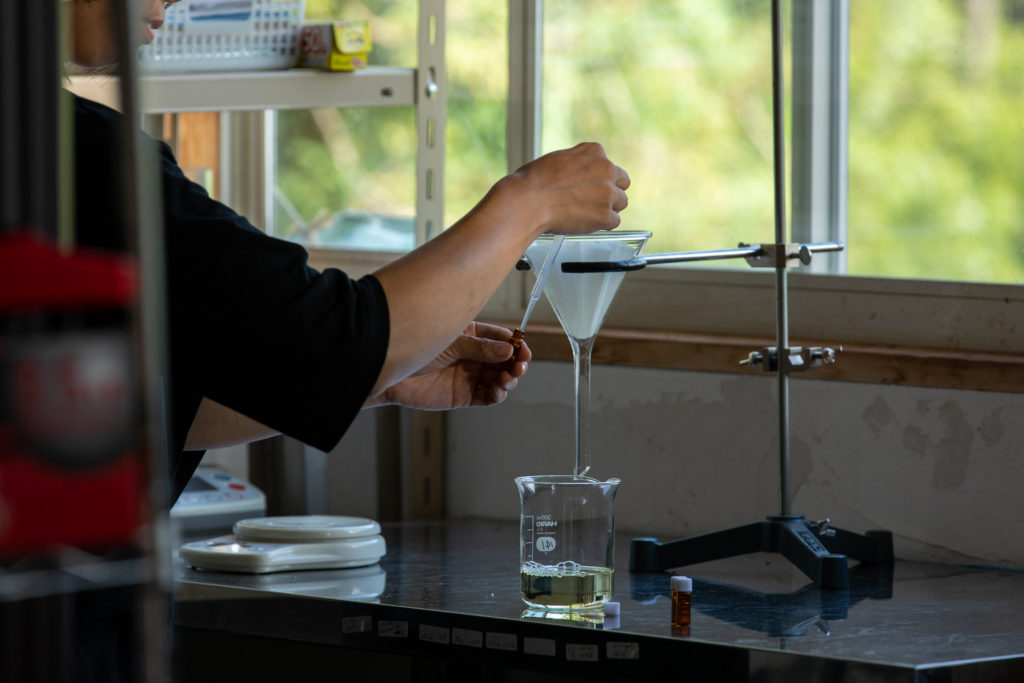
After distillation, the essential oil is separated from the hydrosol and carefully filtered to remove residual impurities. While technically simple, this step is essential for ensuring clarity and stability.
Freshly distilled oil often carries a transient “distillation note,” a warm and slightly earthy aroma present immediately after production. To allow this note to settle and for the true character of the oil to emerge, each batch is rested under controlled conditions.
Aging periods vary by material, and decisions are based on accumulated production data and prior trials. This maturation phase brings balance to the aroma and reveals the essential oil’s authentic profile.
Analytical Evaluation

Once the oil has stabilized, each lot undergoes analytical evaluation. At our Tokyo office, we conduct gas chromatography (GC) and high-performance liquid chromatography (HPLC) analyses to assess chemical composition.
Internal quality standards are defined for each essential oil, and only batches that meet these criteria are approved for shipment. By analyzing every lot in-house, we ensure consistency, purity, and safety.
Quality is verified through data, documentation, and repeatable processes rather than assumption.
Bottling and Delivery

After passing all inspections, the essential oil is bottled and prepared for shipment. Each bottle is filled, labeled, and checked carefully before leaving our facility.
From forest to finished product, every step reflects the combined effort of natural environments, local communities, and technical craftsmanship. Through JapanAroma, these oils are delivered to partners worldwide with the intention that they be used and appreciated in professional applications.